
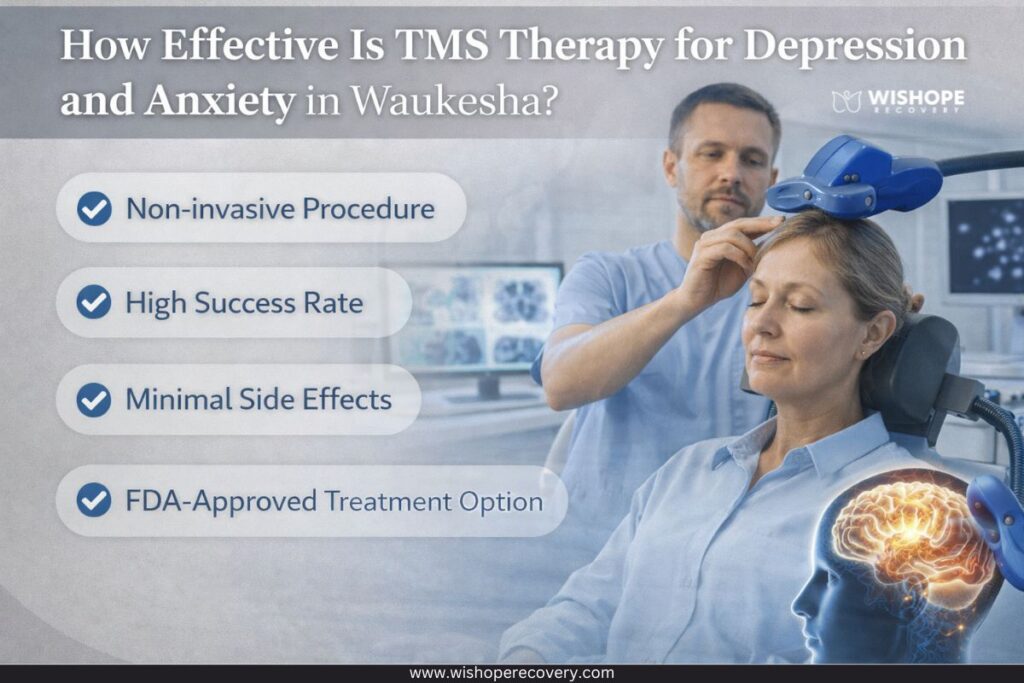
If you are wondering whether TMS therapy really works, the short answer is yes — research shows strong improvement rates for many patients, especially those who have not responded to medication. At WisHope Recovery, we have seen firsthand how transcranial magnetic stimulation therapy can help people regain stability, energy, and hope.
Depression and anxiety can feel overwhelming. When medications and talk therapy are not enough, people often begin searching for something different. That is where TMS steps in as a science-backed, non-invasive option with measurable results.
Let’s break down what the data says and what you should know if you are considering this treatment in Waukesha.
Key Takeaways:
- TMS is a non-invasive, FDA-cleared treatment for depression
- Studies show strong response and remission rates.
- It is especially helpful for treatment resistant depression.
- Anxiety symptoms often improve alongside depression.
- Side effects are typically mild and temporary.
Long-term outcomes show sustained improvement for many patients.
What Is TMS Therapy and How Does It Work?
TMS is a non-invasive procedure that uses magnetic pulses to stimulate specific areas of the brain involved in mood regulation.
During treatment:
- A small magnetic coil is placed against the scalp
- Gentle magnetic pulses stimulate underactive brain regions.
- Sessions last about 20–40 minutes.
- No anesthesia or sedation is required.
Unlike medication, TMS does not circulate through your bloodstream. Instead, it directly targets areas of the brain associated with mood control.
This precision is one reason researchers continue to study TMS effectiveness in people with moderate to severe depression.
Why Do People in Waukesha Consider TMS?
Depression does not look the same for everyone. Some individuals respond well to antidepressants. Others struggle with side effects or limited improvement.
TMS is often recommended for:
- Individuals diagnosed with treatment resistant depression
- People who cannot tolerate medication side effects
- Those seeking a non-medication approach
- Patients looking to improve long-term mental health outcomes
In communities like Waukesha, more individuals are exploring advanced care options beyond traditional prescriptions.
What Does the Data Say About TMS Effectiveness?
When discussing mental health treatment, results matter. Clinical studies consistently show that TMS provides measurable symptom reduction.
Research findings commonly report:
- Significant symptom improvement in over half of the patients
- Meaningful improvement in people who failed multiple medications
- Strong safety profile with minimal long-term risks
When we talk about depression remission rates, studies often show remission in roughly 30–40% of patients, with higher response rates for symptom reduction. These numbers are especially important for individuals who previously felt out of options.
At WisHope Recovery, we focus on tracking real progress through structured assessments before, during, and after treatment.
What Is the TMS Therapy Success Rate in Waukesha?
Patients frequently ask about the TMS therapy success rate Waukesha providers observe. While outcomes vary based on individual history and severity, national data shows:
- Around 50–60% of patients experience noticeable improvement
- A significant portion achieves full or partial remission.
- Many report sustained relief months after treatment.
Success depends on several factors:
- Duration of depression
- Number of failed medications
- Co-existing anxiety symptoms
- Consistency of sessions
TMS is not a quick fix, but it is a well-documented, data-supported treatment option.
Can TMS Help With Anxiety Too?
While TMS is FDA-cleared for depression, emerging research supports its use in anxiety symptoms as well.
Many individuals seeking anxiety treatment Waukesha providers offer are also dealing with overlapping depressive symptoms. When depression improves, anxiety often decreases as well.
Patients commonly report:
- Reduced racing thoughts
- Improved sleep
- Less physical tension
- Greater emotional stability
Because depression and anxiety frequently occur together, improving one condition can positively influence the other.
What Makes TMS Different From Medication?
Medication works systemically. TMS works locally.
Here is how they compare:
Medication
- Travels through the bloodstream
- May cause weight gain, fatigue, or sexual side effects
- Requires daily dosing
TMS
- Targets specific brain regions
- Minimal systemic side effects
- Administered in-office
- No recovery time needed
For people with treatment resistant depression, this difference can be life-changing.
Who Is a Good Candidate for TMS?
You might be a candidate if you:
- Have tried two or more antidepressants without relief
- Experience ongoing depressive episodes
- Prefer a non-medication option.
- Want measurable progress tracking.
At WisHope Recovery, we conduct detailed evaluations to determine eligibility and create individualized treatment plans.
What Does a Typical Treatment Plan Look Like?
A full TMS course usually involves:
- 5 sessions per week
- 4–6 weeks of treatment
- Gradual symptom monitoring
- Follow-up support if needed
Each session is structured, comfortable, and requires no downtime. Many patients drive themselves to and from appointments and return to work immediately after.
What Are the Long-Term Mental Health Outcomes?
Patients want to know if the results last.
Studies show positive mental health outcomes, including:
- Sustained symptom reduction
- Lower relapse rates compared to medication alone
- Improved work and relationship functioning.
- Enhanced quality of life
Maintenance sessions may be recommended in some cases, but many patients maintain improvements long after their initial treatment series.
Are There Side Effects?
TMS is considered safe and well-tolerated.
Common temporary effects may include:
- Mild scalp discomfort
- Light headache after the session
- Tingling sensation during stimulation
Serious complications are rare when performed under professional supervision.
What Questions Should You Ask Before Starting TMS?
Before beginning therapy, consider asking:
- How many TMS treatments have you performed?
- What symptom tracking methods do you use?
- What results have you seen in similar cases?
- Is this appropriate for my diagnosis?
- What insurance coverage options are available?
At WisHope Recovery, patient education is part of the treatment process. Clear expectations lead to better outcomes.
How Does TMS Compare to Other Advanced Treatments?
Other options for severe depression include:
- Medication adjustments
- Ketamine therapy
- Intensive outpatient programs
- Electroconvulsive therapy (ECT)
Compared to these, TMS is:
- Non-invasive
- Does not require sedation
- Does not affect memory
- Backed by years of clinical research
For many individuals in Waukesha, it provides a balanced approach between safety and effectiveness.
What Results Can You Realistically Expect?
Every patient responds differently. However, realistic expectations include:
- Gradual improvement over several weeks
- Noticeable mood lift by mid-treatment
- Increased motivation and clarity
- Reduced hopelessness
Tracking progress is essential. We use symptom rating scales and clinical check-ins to ensure measurable improvement.
Taking the Next Step Toward Real Change
If depression or anxiety has limited your daily life, it may be time to explore a treatment grounded in data and results.
TMS is not experimental. It is an evidence-based option supported by clinical research and real-world patient success.
At WisHope Recovery, our goal is simple: provide compassionate care backed by measurable outcomes. If you are searching for answers in Waukesha, you do not have to navigate this alone.
FAQ
How does TMS effectiveness compare to antidepressants?
TMS effectiveness is especially strong for patients who have not responded to medication. Unlike antidepressants, it directly targets brain regions without systemic side effects.
What are the depression remission rates with TMS?
Research shows depression remission rates around 30–40%, with even higher rates of symptom reduction. Individual response depends on medical history and treatment consistency.
Can TMS help with anxiety treatment that Waukesha residents are seeking?
Yes. While primarily cleared for depression, many patients receiving TMS also report reduced anxiety symptoms, better sleep, and improved emotional balance.
Is transcranial magnetic stimulation therapy safe at WisHope Recovery?
Yes. Transcranial magnetic stimulation therapy is FDA-cleared and widely studied. At WisHope Recovery, treatments are delivered under medical supervision to ensure safety and effectiveness.