
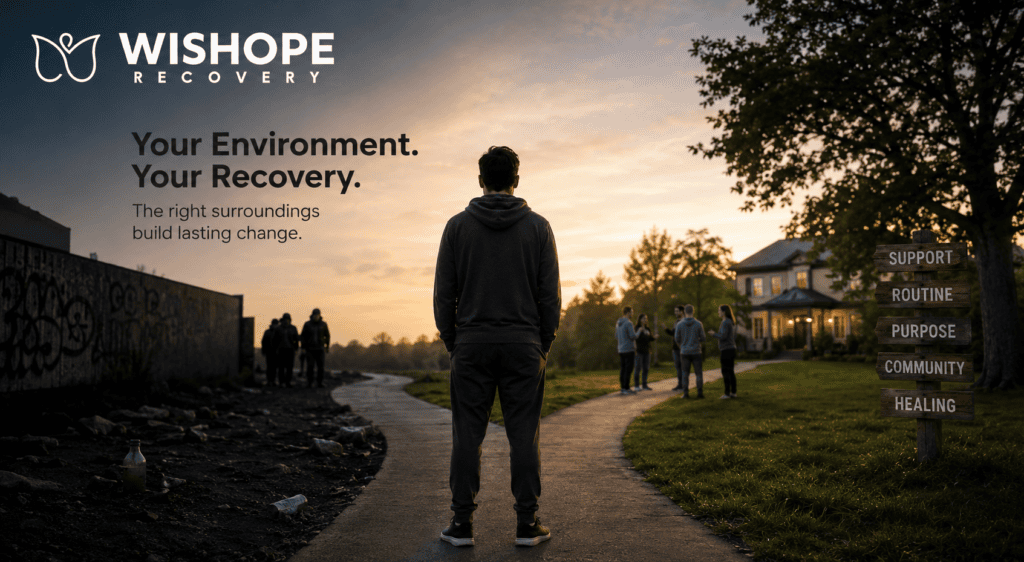
Most treatment plans stop paying attention right around the point where it matters most after someone actually leaves. Nobody plans for the environment they’re walking back into: the same home, the same friends, the same job, the same daily grind. Two people can go through the exact same program and still end up nowhere near each other six months later, and it usually has less to do with the treatment than with what was waiting for them once it ended.
It usually comes down to the surroundings waiting for them afterward: the people they spend time with, the places they pass through every day, and how much stress or stability those surroundings actually offer.
This is the Environment Impact on Recovery that treatment plans rarely spend enough time on, even though it’s often the deciding factor in whether progress actually sticks. So what makes the real difference, and what can actually be done about it?
Is Your Surroundings Secretly Working Against Your Recovery?
Yes, often without anyone realizing it and it’s rarely just about the house. It can be the friend group that never changed, the job that brings constant stress, or a daily routine with too much unstructured time. None of these automatically become safe just because treatment ended. The same people, the same pressures, the same idle hours are still there. A Recovery Environment doesn’t need to be perfect. It needs to stop actively working against the person living in it whether that pressure is coming from home, work, or the people around them.
What Actually Makes a Space Safe Versus Risky?
Nobody needs a spotless house or a perfect family to make this work. What actually matters is smaller and more specific, not much within reach that could trigger old habits, someone nearby who’d notice if something felt off, a day with some shape to it, and somewhere to go when staying put isn’t an option.
According to Research people living in environments with stable routines, supportive social networks, and fewer substance-related cues are more likely to maintain sobriety over time. This is a principle Wishope Recovery builds into care from day one; it holds true at home, at work, and in social settings alike. Without it, even a strong treatment outcome can quietly erode over a few difficult months.
Does It Matter Whether You Choose Residential or Outpatient Care?
Yes , the right setting depends entirely on how safe or unsafe someone’s overall surroundings already are, not on which option sounds more intensive. Residential Addiction Treatment works by removing someone entirely from a compromised environment, which is useful when home, work, or social circles are actively unsafe or unchanged.
Outpatient Addiction Treatment Outpatient keeps someone in their actual life while adding structured support around them. Rebuilding a job, stable housing, healthy relationships so the goal is real independence, not just sobriety. It only works if that environment is already reasonably safe to begin with. Neither format fixes a difficult environment on its own; it just decides how directly someone has to face it, and when.
For a lot of people, a Sober Living Environment has become the practical middle ground here. It’s not a punishment or a step down, it’s a deliberate buffer between “just finished treatment” and “back to fully independent life,” built around Healthy Recovery Habits instead of old routines.
Can Recovery Actually Survive in Isolation?
Rarely. Recovery that depends entirely on one person’s willpower, with no outside support, tends to be far more fragile than recovery built around other people. This is where Addiction Recovery Support does its heaviest lifting:
- Group therapy puts someone in a room with people who’ve been through the same thing. That’s what makes it work even after the meeting ends. The support isn’t tied to a building, it goes wherever the person goes.
- Individual therapy handles the part group work can’t. It gives space to work through the private, specific reasons someone started using in the first place, without needing to explain that history to a room full of people.
Why Do the Most Boring Habits Matter the Most?
It’s not intensity that rebuilds stability, it’s showing up for the same small things every day. Nothing dramatic, just steady.
Wake up consistently: Even with nowhere to be. Sounds pointless, but the body catches onto a rhythm faster than most people expect, and that rhythm does a lot of quiet work keeping cravings and mood swings from spiraling.
Move the body: Even for fifteen minutes it doesn’t need to be a workout; a short walk is often enough to burn off restlessness and give the day some structure before stress builds up.
Track the mood: Writing down cravings instead of letting them stay vague doesn’t need more than a line or two, but putting a feeling into words makes it real enough to notice patterns are easier to catch on paper than in your head.
Show up anyway: Attending scheduled meetings without negotiating matters most on the days someone feels least like going. Skipping ‘just this once’ is often how the habit quietly falls apart.
Eat on schedule: Skipping meals under stress lets low blood sugar and stress compound
each other fast, and a missed meal can turn a manageable day into a much harder one by evening.
Can You Spot a Relapse Before It Actually Happens?
Usually, yes. Most relapses are preceded by identifiable, logistical patterns, not a sudden emotional collapse. Most serious Relapse Prevention work is almost logistical, coming down to a few concrete questions:
- Who’s actually around this week? A short-term shift in someone’s spending time with an old friend back in town, a new roommate can quietly raise risk before anyone notices it happening.
- Where does the day lose structure? Most slips happen in the unplanned hours, not the scheduled ones, so identifying the specific gap in a daily routine matters more than general willpower.
- Which specific setting precedes a slip? Not “trigger” in the abstract, but an actual place, time, or situation naming it precisely makes it far easier to plan around.
People who map this out concretely can make small, unremarkable adjustments to a different route home, a change in who they spend time with, a meeting moved earlier in the day long before a bad moment turns into a full relapse.
Where the Pieces Come Together
Environment isn’t one piece of the puzzle it’s the whole board everything else is played on. This is the real weight behind the Environment Impact on Recovery. A steady Recovery Environment gives daily effort somewhere to land. Real Addiction Recovery Support takes the pressure off one person carrying everything alone. And Healthy Recovery Habits are usually what’s still standing months later, long after motivation fades together, they’re what real Addiction Recovery Success actually looks like.
What Makes Recovery Stick
Most people come out of treatment with the correct tools. What’s in their environment afterwards determines if they will ever use those tools at all. Wishope Recovery plans around that, because it’s usually the part that gets overlooked.
Frequently Asked Questions
What’s the difference between residential and outpatient treatment?
One pulls someone fully out of their environment, the other keeps them in it with extra support layered on. Wishope Recovery helps people figure out which path actually fits.
How does the environment affect addiction recovery?
Daily triggers, stress, and support all come from the environment and that often matters more than treatment itself did.
Why does a sober living environment help with recovery?
There’s enough structure to keep risk low, but not the round-the-clock supervision residential care requires.
Can you recover without changing your environment?
Sure, it happens. It’s just rare that most people who stay sober end up changing something about their surroundings along the way.
How can I avoid relapse triggers in my environment?
Pay attention to who’s around, where the day loses shape, and what settings tend to show up right before a slip.