
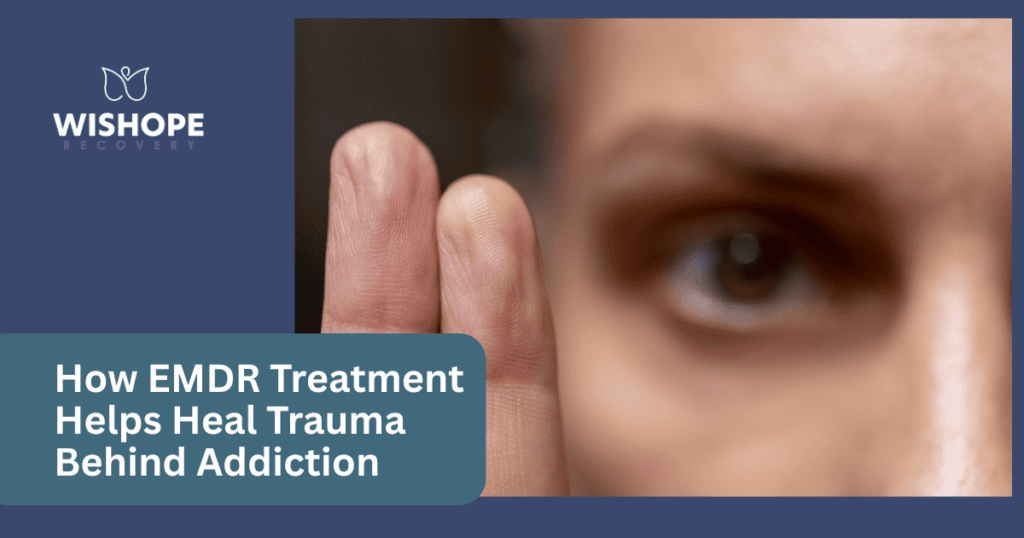
For millions of Americans, substance use serves as a means to deal with unresolved trauma, such as painful memories that were never fully healed. Current approaches to addiction therapy concentrate on managing cravings and withdrawal. However, they do not address the underlying problem. That’s where EMDR treatment for addiction comes in as a revolutionary, evidence-based approach to addiction.
EMDR treatment for addiction therapy works on the underlying memories that lead to addictive tendencies. At WisHope Recovery, we believe that healing from underlying trauma is key to a successful break from addiction. Our cutting-edge therapy programs are specifically designed to do just that. If you are prepared to confront what’s actually driving your addiction, then WisHope Recovery can offer you personalized care through evidence-based therapy.
Key Takeaways
- One of the most important underlying causes of addiction or substance abuse is trauma.
- EMDR, a treatment for addiction, helps rewire the brain’s response to traumatic memories.
- Eye movement desensitization therapy is a clinically proven method, supported by organizations such as the WHO and APA.
- EMDR therapy for substance abuse is most effective when it is part of a comprehensive dual diagnosis treatment plan.
- Treating trauma with trauma therapy for addiction has a profoundly positive impact on long-term recovery.
What Is the Trauma and Addiction Connection?
The trauma and addiction connection comes from how our brain responds to stressful situations. When a person does not deal with their traumatic experiences, their brain will remain in a constant state of alert, leading to a need to self-medicate to alleviate their suffering.
PTSD and addiction frequently co-occur. Research in the Journal of Traumatic Stress has already confirmed that individuals suffering from PTSD are 2-4 times more likely to develop a substance use disorder in comparison to those who do not suffer from PTSD. This is exactly why it is very important to treat PTSD and addiction treatment conditions simultaneously.
How Does EMDR Therapy Work?
How EMDR therapy works is based on brain science. Psychologist Francine Shapiro discovered this therapy in the late 1980s. During an Eye Movement Desensitization Therapy session with a patient, the patient is asked to recollect a memory of a traumatic event while following a moving object with their eyes. The moving object is normally a finger or a light bar moved back and forth.
The process is similar to the way the brain works during REM sleep. After several sessions with an EMDR therapist, the patient greatly reduces their emotional connection to the memory of the traumatic event. The memory persists, but the patient remains unaffected by it and does not turn to substance abuse.
Why is EMDR so effective for addiction treatment?
EMDR therapy for substance abuse is very effective because it treats the root cause of the addiction, not the addiction itself. This is why it stands out above the rest:
- It eliminates trauma triggers:
EMDR therapy for substance abuse eliminates trauma triggers, reducing the chances of a relapse. - It helps restore normal emotional responses:
EMDR treatment for addiction helps the mind restore normal ways of handling emotions. - It is more effective than traditional talk therapy:
Measurable results are achieved within 6-12 EMDR treatment sessions. - It treats co-occurring disorders:
EMDR benefits for PTSD and addiction are well praised, as it treats both simultaneously. - It is a non-invasive treatment:
Unlike other treatments, EMDR does not require medication and has no physical side effects.
What Are the EMDR Benefits for PTSD and Addiction?
The EMDR benefits for PTSD and addiction are not limited to just managing the symptoms. There have been studies that showed that using EMDR therapy can actually reduce the severity of PTSD symptoms, cravings, and sleep, as well as emotional strength, all of which are necessary for a successful recovery.
A landmark study published in PLOS ONE showed that using EMDR therapy significantly reduced PTSD symptoms as well as cravings for those who are suffering from co-occurring disorders. This has made it a standard therapy for PTSD and addiction treatment.
How Do Trauma Therapy Programs Utilize EMDR?
A good trauma therapy program will incorporate EMDR therapy as part of a holistic treatment plan. In a forward-thinking rehab center, EMDR therapy is used alongside:
- Cognitive Behavioral Therapy (CBT) to correct distorted thinking patterns
- Medication-Assisted Treatment (MAT) to control withdrawal symptoms
- Group therapy for a sense of community and shared experiences
- Mindfulness therapy to increase present-moment awareness
This multimodal approach is the core of dual diagnosis treatment, where the addiction and the mental health issue are treated simultaneously.
Is EMDR a Suitable Option for Trauma-Based Addiction Treatment?
Trauma therapy for addiction is not a generic approach, although EMDR is seen as a powerful solution for those who have suffered from:
- Childhood abuse, neglect, domestic violence, etc.
- PTSD symptoms along with addiction
- Failed conventional therapy
- A desire to understand the underlying causes of their addiction.
Start Your Healing Journey at WisHope Recovery
At WisHope Recovery, we understand how important it is to receive care that addresses your overall well-being, not just your addiction. Our team of clinicians will work with you to develop a personalized dual diagnosis treatment plan. We utilize evidence-based therapies such as EMDR, CBT, and holistic approaches. You do not have to carry your past with you into your future. Let WisHope Recovery help you heal what hurts.
FAQs:
How many sessions of EMDR are required?
On an average, people experience significant improvement with 6 to 12 sessions. However, the number of sessions may vary.
Is EMDR covered by insurance for addiction treatment?
EMDR is covered for addiction treatment if it is part of a supervised clinical program.
Can EMDR be used with other forms of addiction treatment?
Yes. EMDR is used in conjunction with other forms of addiction treatment.
How can I get EMDR-based addiction treatment?
WisHope Recovery offers trauma-informed care for addiction using EMDR. Visit wishoperecovery.com for more information.